
Trivia
As the site develops we will add any Trivia that we find to this page
Editors
1926 - 1930 - Edgar Jackson
The founding editor. A former drummer and dance-band leader, he shaped the paper’s early years as a monthly trade magazine for working musicians and introduced its first jazz column.
1930 - 1940 - P. Mathison Brooks
1940 - 1949 - Ray Sonin
Oversaw the monumental transition from a monthly magazine to a weekly newspaper format in May 1933.
Steered the paper through World War II amidst severe paper rationing and staffing shortages, maintaining a heavy focus on swing, jazz, and the wartime contributions of musicians. (He later left to join the rival NME).
1949 - 1962 - Pat Brand
Led the paper through the post-war recovery era. Brand managed the publication during the birth of rock 'n' roll, keeping the paper somewhat traditional but gradually adapting to the 1950s youth explosion.
1962 - 1970 - Jack Hutton
Modernised the paper into a weekly layout that could successfully compete in a rapidly growing rock market. He departed in 1970 to launch a direct rival weekly, Sounds.
1970 - 1978 - Ray Coleman
The editor during the "Golden Era" of progressive and glam rock. Coleman was incredibly well-connected (famously close with The Beatles) and pushed for a more professional, "broadsheet" investigative style of rock journalism.
1978 - 1980 - Richard Williams
Attempted to steer the paper in an intellectual, art-school direction to capture the post-punk and New Wave movement, hiring legendary writers like Jon Savage and Vivien Goldman. Left after internal clashes with Coleman (who was still Editor-in-Chief) over design and direction.
1980 - 1984 - Michael Oldfield
Promoted from the design staff, his brief tenure moved the paper back toward a more traditional, conservative rock layout and populist pop coverage (such as Duran Duran).
1984 - 1997 - Allan Jones
The longest-serving weekly-era editor. On his very first week, he famously defied management orders to put pop group Kajagoogoo on the cover, opting for the rising indie stars The Smiths. He championed the indie, grunge, and Britpop movements before leaving to found Uncut magazine in 1997.
1997 - 2000 - Mark Sutherland
The final editor. Brought in from Smash Hits and NME to modernise the paper's declining sales. He oversaw the late-90s transition to a glossy, stapled magazine format before its final merger with NME.
The "Two Rays" and the NME:
-
Both Ray Sonin (editor in the 40s) and Ray Coleman (editor in the 70s) are key figures in UK print history. Sonin actually crossed the floor to work for rival New Musical Express (NME) after his tenure at MM.
Great Walkout of 1970:
-
When Jack Hutton left in 1970, he didn't go alone. He took a massive portion of the Melody Maker writing staff with him to launch Sounds, forcing incoming editor Ray Coleman to scramble and recruit an entirely new generation of provincial journalists.
Publication Dates
Like most publications in the UK there were varied dates on the cover than when it was made available. Here is a bit of a breakdawn.
Era
Actual Street Date
(When fans bought it)
Cover Date
(Printed on the front)
May 1933 – Late 1940s
Thursday
Late 1940s – August 1980
Thursday
September 1980 – December 2000
Wednesday
Friday / Later Saturday
Saturday
Saturday / (Later transitioned to weekly date ranges in the glossy late-90s era)
Why did they print a date in the future?
In the UK retail trade, newsagents would routinely strip the covers or return unsold weekly papers.
If a paper had a Thursday cover date, a casual buyer on Friday morning might think, "Oh, this is yesterday's news," and skip it.
By printing Saturday on the cover, the publisher guaranteed the paper felt "fresh" and stayed on the shelf for a full 48–72 hours after it actually debuted on Thursday / Wednesday.
In London the publication came out a day earlier (Wednesday / Tuesday) especially in places like Tottenham Court Road and Soho. This was due to the proximity to the printing press buildings.
The Ads That Launched Bands
While other music papers focused entirely on fans, Melody Maker’s superpower was that it was read by actual, working musicians. Its classified ads section (often called the "Musicians' Registry") is responsible for forming some of the most famous bands in music history:
David Coverdale & Deep Purple:
In 1973, Deep Purple placed an anonymous ad in Melody Maker looking for a new singer. A young, unknown boutique shop assistant named David Coverdale sent in a tape and got the gig.
The Birth of Supertramp:
In 1969, a Dutch millionaire named Stanley August Miesegaes offered to financially back keyboardist Rick Davies to form a new band. Davies simply placed an ad in Melody Maker to recruit the rest of the lineup.
Depeche Mode’s Keyboardist:
In late 1981, Depeche Mode placed an ad reading: "Name band, synthesise, must be under 21." Alan Wilder answered it, lied about his age (he was 22), and became a crucial architect of their sound.
Erasure:
Vince Clarke (formerly of Depeche Mode and Yazoo) placed an ad in MM in 1985 looking for a vocalist. Andy Bell answered it, and Erasure was born.
Suede:
In 1989, Brett Anderson and Mat Osman placed an ad in Melody Maker looking for a "guitartist." A young Bernard Butler answered it. Later, wanting to expand their sound, they placed another ad looking for a keyboardist. It was answered by none other than Justine Frischmann (who later went on to front Elastica).
Placebo:
Looking for a drummer in 1996 to record their debut album, Brian Molko and Stefan Olsdal placed an ad in Melody Maker. Steve Hewitt saw the ad, auditioned, and completed the classic Placebo lineup.
The Relaunch Date & Format Change
Glossy Transition of the 90's
Fighting a battle against dwindling circulation in the late '90s, Melody Maker made a desperate, final gamble to reinvent itself.
This is the story of the "Glossy Era"—a radical format shift that changed the paper forever.
The First Issue:
The first issue of the glossy format hit shelves on Wednesday, 30th October 1999.
A free sampler edition previewing the change was distributed the week prior, on 23rd October, featuring Cerys Matthews of Catatonia on the cover.
The Physical Shift:
For 66 years, Melody Maker had been a broadsheet or tabloid newspaper printed on cheap, ink-staining newsprint.
On the 30th October 1999, it shrunk down to a standard A4-sized, stapled, glossy magazine.
The Masthead:
The traditional red-and-white Melody Maker logo was updated to a bold, cartoonish white font with a black border.
The Price Point:
The price stepped up slightly to £1.00 (denoted by a bright yellow "New Look" badge).
The Date Range:
Instead of pointing to a single Saturday cover date, the date reads "Nov 24 - Nov 30 1999" to reflect its week-long shelf-life as a magazine.
Layout:
The cover art became much cleaner and more conceptual, utilizing full-bleed imagery that wouldn't have printed cleanly on cheap newsprint.
The Freebies:
To entice readers, the launch issue was packaged with a free CD covering BBC Radio 1’s Sound City festival in Liverpool.
These visual changes highlight just how dramatically the publication tried to distance itself from its legacy as a traditional music newspaper to compete with the glossy monthlies of the era.
23rd October 1999
Final Newsprint Issue
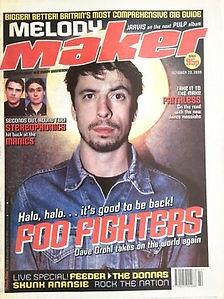
30th October 1999
First Glossy Issue

The Strategy: Distinguishing from NME
By 1999, both Melody Maker and NME were owned by the same publisher, IPC Magazines.
Having two weekly newsprint titles competing for the exact same alternative/indie rock reader was eating into IPC's own profits.
IPC’s management, led by publishing director Robert Tame and MM editor Mark Sutherland, devised a plan to split the two papers' target audiences:
The NME would remain the serious, traditional weekly "inkie" for older, dedicated indie purists.
The Melody Maker was repositioned as a glossy, younger, and more vibrant alternative rock magazine.
The Target Audience:
The new target demographic was specifically 16-to-19-year-olds. The goal was to bridge the gap between "teenybopper" pop titles like Smash Hits and the ultra-serious music press. It was designed for teenagers who were just growing out of mainstream pop and discovering bands like the Foo Fighters, Muse, and Feeder.
Visual and Editorial Style
The glossy era looked vastly different from the classic, intellectual Melody Maker of the '70s and '80s:
High-Impact Visuals:
The cover designs became incredibly loud, using bright neon borders, large fonts, and high-quality glossy artist photography rather than gritty live shots.
Less Text, More Bite: Articles were shorter and punchier, with more Q&As, pull-quotes, and visual sidebars.
The "Maker Breakers" Section: A major focus of the glossy era was championing brand-new, breaking bands. This section helped early-career acts like Muse, Coldplay, and Groove Armada secure some of their earliest weekly cover-style exposure.
The Reaction and Initial Success
Initially, the gamble seemed to work. Because the magazine was now bright and glossy, it stood out on newsagents' shelves next to the grey newsprint of NME.
In the first few months of 2000, editor Mark Sutherland reported that audited sales figures for the new format rose by 11%. Younger readers, particularly sixth-form students looking for an "alternative" identity, warmly received the changes.
The Rapid Decline and Final Merger
The honeymoon period was incredibly short. By mid-2000, the reality of the dying weekly print market caught up with them.
The Rise of the Internet:
Bands were starting to launch their own websites, and music news was migrating online, making a weekly paper less essential.
Fragmentation of Music:
The late '90s and early 2000s saw a massive boom in dance music, hip-hop, and pop. The guitar-centric indie market was shrinking, and specialized monthly magazines (like Mixmag or Ministry) were capturing the youth culture.
The Sales Crash:
By May 2000, just seven months after the glossy relaunch, Melody Maker's circulation plummeted by 21%.
The Final Blow:
Seeing that the weekly market could no longer sustain two alternative titles, IPC chose to save NME. On Wednesday, 20 December 2000, the final issue of Melody Maker was published.
In January 2001, it officially merged into NME.
For a short time, the NME masthead featured the small subtitle "incorporating Melody Maker," and several MM journalists transferred over, but the distinctive voice of the Maker was officially gone.
Various Trivia
The "Musicians' Bible" and Gear Reviews
Unlike the NME, which was written strictly for consumers and pop fans, Melody Maker actively catered to music creators.
For decades, it regularly featured instrument reviews, technical columns on amplification, and printed sheet music for popular songs.
This focus earned it the industry nickname "The Musicians' Bible."
Because of this reputation, music instrument manufacturers ran massive, beautifully illustrated full-page ads for guitars, drums, and synthesizers.
The "Inkies" Physical Reality
The nickname "the inkies" (used for Melody Maker, NME, and Sounds) was highly literal.
Because they were printed cheaply on massive web-offset newspaper presses right up until the night before publication, the black ink never fully dried before hitting shelves. A teenager reading Melody Maker on the bus home on Wednesday afternoon would invariably end up with completely blackened, ink-stained fingertips and palms. It was a badge of honor!
"The MM Files: Famous Firsts"
Throughout its 74-year run, Melody Maker was home to some of the most influential, ground-breaking, and historic interviews in music journalism. Here is a curated selection of the landmark moments that shaped music history.
The Interview That Launched Glam Rock (David Bowie, 1972)
In January 1972, Melody Maker journalist Michael Watts interviewed a relatively under-the-radar David Bowie, who was promoting Hunky Dory.
During the interview, Bowie casually dropped a bombshell: "I'm gay, and always have been, even when I was David Jones."
Why it's great trivia:
It was a shocking, calculated media move for 1971/72. Accompanying the text was a photo of Bowie wearing a "man's dress". The interview immediately skyrocketed Bowie's profile and is widely credited as the official "day zero" of the UK's glam rock explosion.
Pushing the Government for The Beatles' MBEs (1965)
On 6th March 1965, the paper ran a passionate editorial calling on the British state to officially honour The Beatles for their massive contribution to British exports and global prestige.
Just three months later, on 12th June 1965, Prime Minister Harold Wilson's government did exactly that, appointing all four Beatles as Members of the Order of the British Empire (MBEs).
The "Denmark Street" Origins (1926)
Before it became a massive media empire, Melody Maker was literally a basement operation.
It was founded in 1926 by composer Lawrence Wright as a house newsletter to plug his own sheet music publishing business.
Its very first office was in the basement of 19 Denmark Street in London—the street that would go on to become the legendary "Tin Pan Alley," the absolute heart of the UK music publishing and instrument trade.
The First Ever British Interview with Louis Armstrong (1932)
Because Melody Maker was initially a jazz-and-dance-band publication, it has deep historical ties to the jazz age.
In July 1932, during his first-ever tour of the UK, the legendary Louis Armstrong sat down with Melody Maker for his first-ever British press interview. The paper treated him like royalty at a time when mainstream newspapers were incredibly dismissive or outright hostile to black jazz musicians.)
The "Monotony Maker" Parody (1973)
During the early 1970s, as Melody Maker grew highly intellectual and deeply analytical about progressive rock, it became a bit of a target for the cynical "underground" counterculture.
In 1973, the famous underground newspaper International Times (IT) printed a highly detailed, savage, four-page parody of the paper titled "Monotony Maker". It relentlessly mocked Melody Maker's obsession with endlessly interviewing jazz-fusion virtuosos and progressive rock keyboard rigs.
Pete Townshend's Diary Columns (1970–1971)
In 1970, The Who’s guitarist Pete Townshend signed up to be a regular monthly columnist for Melody Maker.
Rather than simple PR fluff, Townshend wrote incredibly raw, intellectual, and deeply personal diary-style essays.
He discussed his frustrations with the music industry, his spiritual journey with Meher Baba, and even wrote the very first public outlines of what would eventually become Lifehouse (the abandoned sci-fi rock opera that turned into the album Who's Next).
The Postal Strike and the Album Charts
From 1958 to 1988, Melody Maker compiled and published its own highly respected, independent UK Album Chart. Normally, the "official" charts were compiled by the British Market Research Bureau (BMRB). However, in early 1971, a massive national postal workers' strike ground the UK to a halt.
Because the BMRB relied on postal diaries from record shops to compile the official charts, they suddenly couldn't make them. Melody Maker, which collected its data via telephone from over 200 shops, kept its chart running. For an 8-week period in 1971, the official record of UK album sales was officially substituted with Melody Maker’s proprietary chart!
Caroline Coon and the Punk Explosion
In the mid-1970s, Melody Maker writer Caroline Coon became a legendary figure by championing the rising punk movement.
While mainstream media and even other music papers initially dismissed bands like the Sex Pistols and The Clash as talentless thugs, Coon wrote passionate, front-page defenses of the movement. She is widely credited with bringing the "punk" aesthetic and its DIY feminist undercurrents into the national conversation.
The First to Treat Rock Seriously
In the 1950s, the weekly music press treated rock 'n' roll as a silly, short-lived teenage fad. In 1964, Melody Maker underwent a massive shift under editor Jack Hutton.
It became the first UK weekly to treat pop and rock musicians as serious artists rather than disposable teen idols. They began running long, intellectual, deep-dive interviews with artists like Bob Dylan, The Beatles, and Jimi Hendrix, effectively pioneering the concept of modern rock journalism.
Cover Price
Tracking cover price changes is a way to map the economic history of Melody Maker.
Like most British periodicals, its pricing reflects decades of inflation, decimalisation, and the late-90s transition to a glossy format.
Because it ran weekly for nearly 70 years, there were dozens of tiny price increments (often just a penny or two at a time). However, the list below highlights the most significant price milestones and the years they occurred. We will add in the exact dates as we find them.
The Pre-Decimal Era (1926–1971)
Before the UK converted to decimal currency in February 1971, Melody Maker was priced in shillings (s) and pence (d).
Date / Era
January 1926 - February 1926
March 1926
Cover Price
3d (Three old pence)
6d
Historical Context
The launch price of the original monthly magazine.
Went up with the 3rd issue of the magazine
1940s (WWII)
4d
Raised slightly due to severe wartime paper rationing and increased production costs.
Late 1950s
6d
The price during the early birth of rock 'n' roll and the launch of the MM charts.
Late 1960s
1s (One shilling)
Reached the "one shilling" milestone as the paper expanded to cover progressive rock.
Late 1970
1s 6d (1 shilling, 6 pence)
The final price tier of the old £sd currency system
The Decimal Era & Great Inflation (1971–1989)
On 15th February 1971, the UK decimalised its currency. 1s 6d converted to exactly 7½p.
The high inflation of the 1970s and 80s forced publishers to hike prices almost annually.
Date / Era
February 1971
1974
1976
Cover Price
8p
12p
15p
Historical Context
Rounding up slightly post-Decimal Day.
Mid-70s glam and prog rock boom.
The price at the dawn of the UK Punk explosion.
1979
25p
Reflecting high UK inflation at the end of the decade.
September 1980
1982
1985
30p
The price when the paper shifted from Thursday to Wednesday distribution.
40p
50p
The New Romantic and synth-pop era.
Reached the half-pound milestone during the peak indie-pop/goth years.
1988
65p
The end of the MM album charts era.
The 1990s & The Glossy Final Frontier
By the 1990s, weekly music papers were increasingly expensive to produce relative to their falling circulations, causing prices to climb past the pound mark.
Date / Era
1991
1994
Late 1996
30th October 1999
Cover Price
80p
90p
95p
£1.00
Mid 2000
£1.10
December 2000
£1.10
Historical Context
The heights of Shoegaze and Baggy/Madchester.
The peak Britpop rivalry era (Oasis vs. Blur).
The final price tier of the classic newsprint "inky" format.
The Glossy Relaunch. The price jumped to £1.00 to mark the shift to a stapled A4 magazine.
A final price hike in a desperate bid to offset falling ad revenue.
The final cover price when Melody Maker printed its last issue.
Non-published dates
From time to time Melody Maker was not published due to
Industrial action. Below are the dates which were affected
(As we find them).
1900
Due to industrial action
no issues were published on
00th
Therefore 00th